ReViFES
Institute: NIOZ, WUR, WMR
Period: 2020 – 2025
Funding Source: NWO-TTW
Biogenic reefs are complex structures built by organisms such as mussels, flat oysters, sand worms and honeycomb worms. They form the basis of rich habitats and complex ecosystems in the North Sea. Despite their crucial role and unique biodiversity, these reefs have largely disappeared due to human activities that disturb the seabed. Determining the extent of the ecosystem services that these reefs provide is essential to assess the impact of their decline and to understand how these reefs can be restored.
NIOZ, Waardenburg Ecology, TU Delft, and Wageningen University & Research (WUR) are collaborating, with NIOZ as programme lead and Waardenburg Ecology as one of the designers of the research programmed make the science accessible to a broader professional audience, including those involved in practical applications and offshore operations.
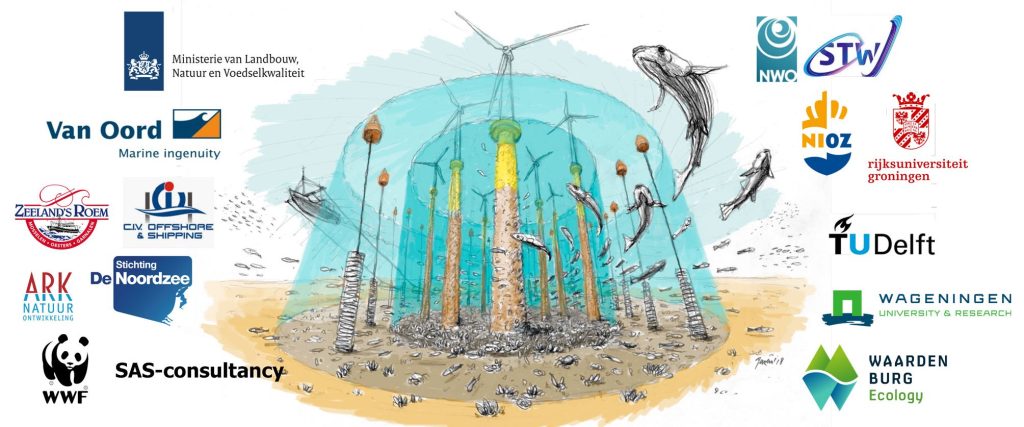
NWO-TTW, ARK Rewilding, CIV, Ministerie van LVVN, Natuur & Milieu, Roem van Yerseke, Sas Consultancy, Stichting de Noordzee, Van Oord, Waardenburg Ecology, WWF are partners in the project.
Lessons learned
The content is structured around the program’s four building blocks:
- Ecosystem services of natural reefs (Part 1). Empirical data of the value and services of temperate North Sea reefs.
- Techniques for native oyster hatcheries and oyster settlement (Part 2). New innovations that contribute to a source of oysters for native oyster restoration.
- Scientific data on enhancement measures in wind farms (Part 3). Biodiversity gain of reef integrated designs in offshore wind farms.
- Design principles for reef restoration and reef enhancement in wind farms (Part 4).
Direct references to the underlying scientific studies make it easy to understand the designs and background studies. For those who prefer images to text, illustrations offer an alternative.
Team Members