ASSESS
Institute: Wageningen University and Wageningen Marine Research
Period: Nov 2022 – Feb 2027
Funding Source: TKI Deltatechnologie, INSITE North Sea
The presence of artificial structures—such as platforms, wind farms, and other energy installations—introduces hard surfaces into soft seabed environments. These surfaces provide a home for new communities of marine organisms, such as mussels, anemones, hydroids, and even soft corals. By creating these new habitats, artificial structures can thereby alter local biodiversity, food webs, and nutrient cycling. With the rapid expansion of offshore renewable energy, understanding these impacts in the North Sea has become more important than ever.
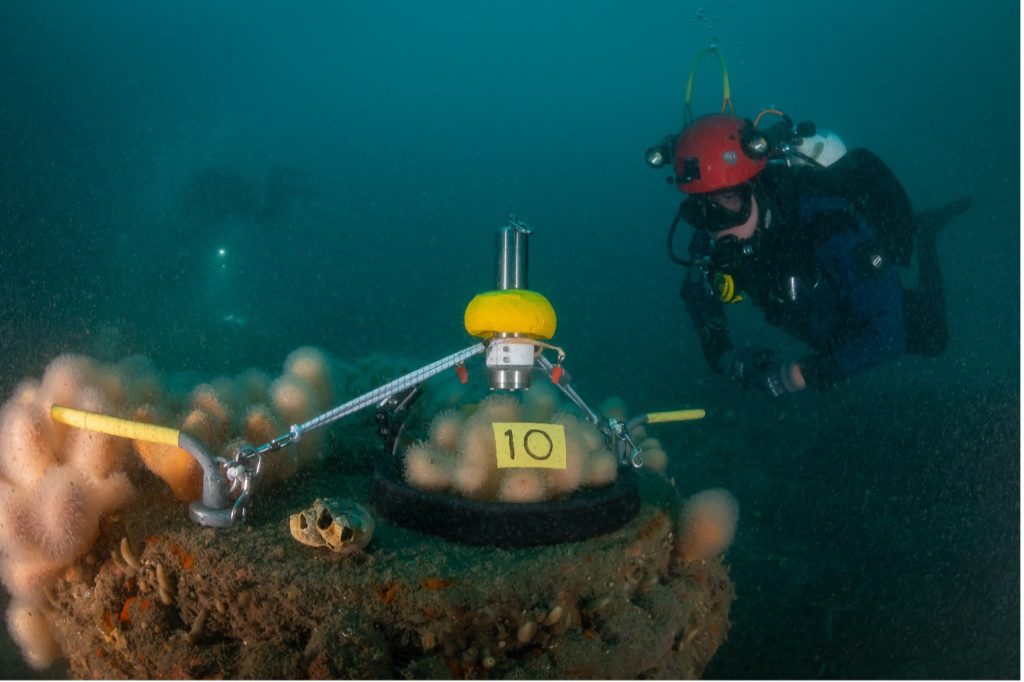
Our project aims to quantify these changes by studying both the artificial structures and the surrounding seabed, focusing on structures that have been in place for more than 20 years. Our team investigates the local food web by collecting stable isotope samples on and around a platform. We also use a self-developed incubation chamber to measure respiration and nutrient cycling in the three main communities types: mussel-, amphipod-, and anemone-dominated.
To understand how organisms living on the structures—and their feces—affect nearby sediments, we also perform incubation experiments on sediment cores using algae labeled with heavy carbon isotopes. By tracing this carbon through the system, we can see how organic matter moves through the compartments close to and farther from the structures, revealing changes in ecosystem functioning caused by these human-made installations.
Linked Staff:
- Marjolijn Christianen (https://penyu.nl/about-2/)
- Joop Coolen (WMR)
- Ninon Mavraki (WMR)
- Jaap van der Meer (WUR)
Team Members