WildMarsh
Institute: Wageningen University, Netherlands Institute of Sea Resarch
Period: 2025-2030
Funding Source: NWO ENW-M2
With 38% of global salt marshes lost or severely degraded, their vital roles in coastal protection and carbon sequestration are under siege, making the need to scale up restoration effectively evident. Trophic rewilding (TR) is a restoration approach that promotes self-regulating, biodiverse ecosystems through active reintroductions or passive management of large animals. Although rewilding is already being implemented, we still need to learn how it works and impacts biodiversity and ecosystem resilience under current and projected climate change scenarios.
The WildMarsh project aims to build a strong scientific foundation by investigating how TR affects ecosystem functioning and resilience in salt marshes, particularly against sea level rise, climate-change-induced storms, and heatwaves, and how these effects vary across different climatic gradients in European salt marshes.
Ecosystem-wide effects of active rewilding
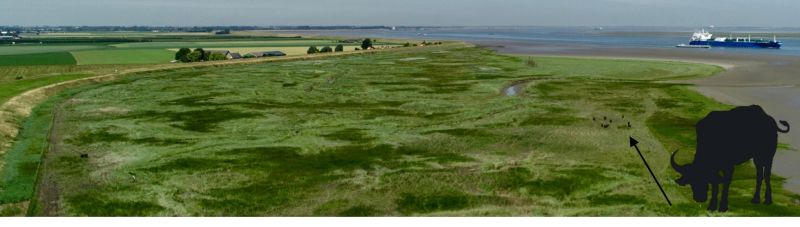
 On the Schor of Baalhoek, part of the Verdronken Land van Saeftinghe, a small herd of water buffaloes was introduced in 2021. Unlike other grazers, for example cows, water buffaloes use the entire area, can move through deeper creeks, and also feed on coarser vegetation such as reed. This can open up space for new salt-marsh plants, promoting regeneration. Combined with changes in root biomass, plant productivity, and sediment retention, this boost in biodiversity could help create a more resilient ecosystem, better able to cope with climate change. In 2025, WildMarsh began studying this form of active rewilding by comparing the effects in- and outside existing exclosures (fenced areas where buffaloes cannot enter). To get a comprehensive view of how trophic rewilding affects the ecosystem as a whole, we examine various ecosystem functions, such as plant and insect diversity, carbon storage, and resistance to erosion. In addition, we use remote sensing tools and models to understand the effects of rewilding on the biogeomorphological processes that determine the dynamics of the area. Specifically, we investigate whether changes in vegetation and the morphological consequences of trampling have a positive or negative impact for example, on the potential for a salt marsh to keep pace with sea-level rise. We also use these tools to upscale field results, gaining insights into the overall impact of trophic rewilding. Ultimately, we aim to develop indicators that can be used to quickly and simply detect the effects of trophic rewilding and support decision-making for its application in European salt marshes.
Effects of passive rewilding on marsh expansion
In addition to Baalhoek, we also study the Hedwige Polder, a young marsh that was formerly farmland, adjacent to the Verdronken Land van Saeftinghe. Since 2022, it has been returned to the sea and is now rapidly developing. This young marsh is used by various waterbirds, including many geese, and by deer moving in and out of the area. In 2025, WildMarsh started investigating the effects of passive rewilding here, focusing on how grazing influences salt marsh expansion.
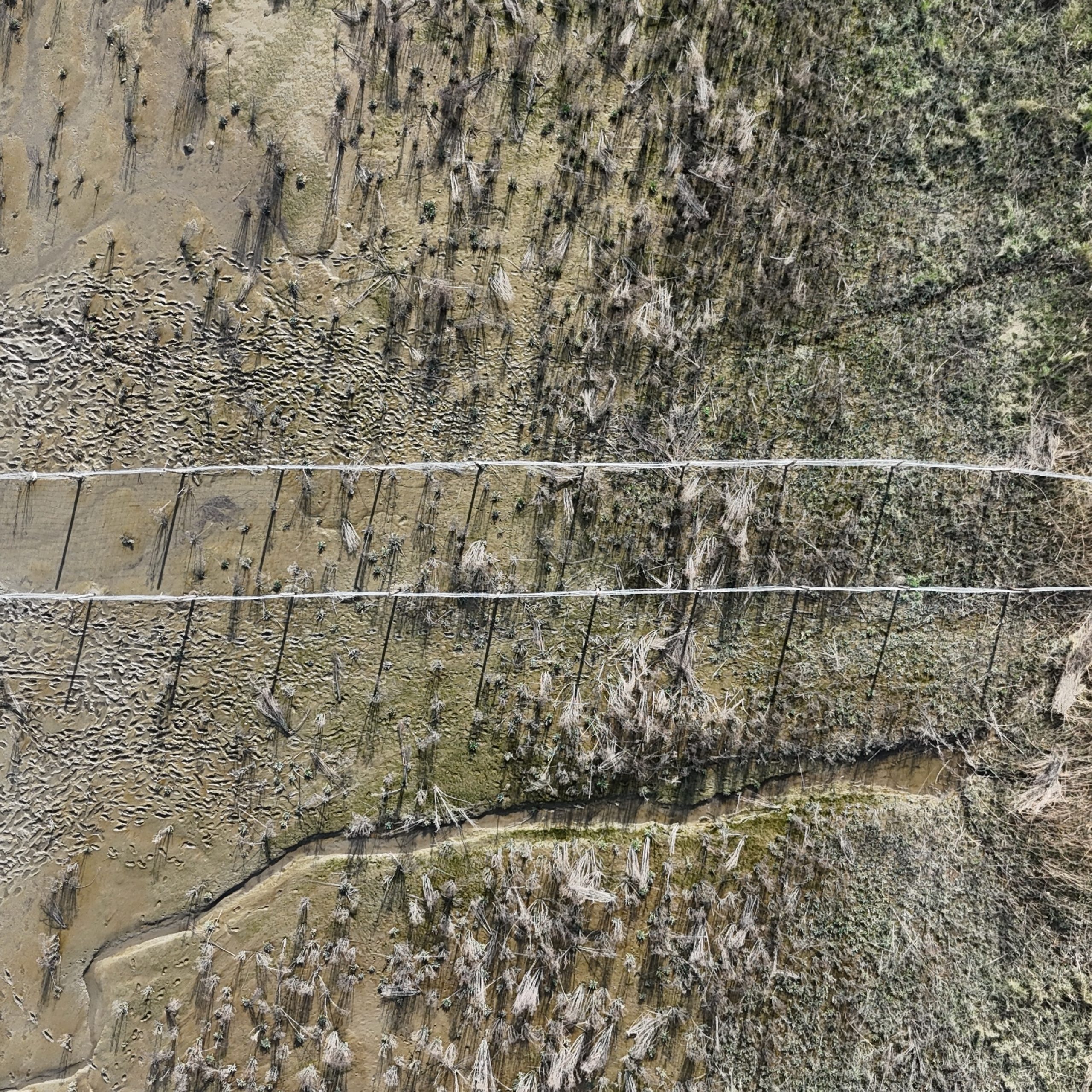 In March 2025, we built six large exclosures (40 × 3m) to monitor land expansion toward the sea with and without grazing. These sites are monitored regularly, and we frequently capture multispectral drone imagery to study changes both inside and outside exclosures. Using this remote sensing data, we can not only assess salt marsh expansion but also analyze other indicators such as vegetation diversity and succession, as well as creek development.
Europe-wide comparison
With these two sites, we aim to gain a broader understanding of different forms of trophic rewilding at various stages of marsh development. We are also interested in how these effects vary across other climate zones. Therefore, in 2026, we will conduct research along the European coastline to study the effects of TR across different climatic zones (Baltic and boreal, North Atlantic, South Atlantic, and Mediterranean), comparing marshes with and without active rewilding. This will involve a combination of measuring ecosystem functions and We study ecosystem dynamics through a combination of field measurements and remote sensing using multispectral drone imagery. We aim to collaborate with local managers or researchers in each country. Please feel free to reach out if you know more about this or are interested in collaborating!
Trophic rewilding under local and global stressors
To better understand how trophic rewilding functions under various local and global stressors, we will conduct a mesocosm experiment from 2026 to 2028 at Sinderhoeve (Wageningen Environmental Research), where we will expose salt marsh plants to different stressors, such as heatwaves, increased storminess, and sea level rise.
Rewilding opportunity map
With all the data collected and together with other stakeholders, we hope to eventually create a map, showing the potential for trophic rewilding across European salt marshes, under current and future trophic rewilding scenarios.
Collaborations
This project is a collaboration between Wageningen University and NIOZ, coordinated by Marjolijn Christianen in collaboration with Jim van Belzen. Other team members are Oscar Franken (NIOZ), Celine van Bijsterveldt (WUR), Pim Willemsen (WUR, Deltares), Roeland van de Vijsel (WUR). In addition, we work with artists Mirthe Dokter and Tim Hammer from Pollif Projects to translate scientific insights into accessible forms for a wide audience; providing practical guidance for restoration and expressing through art what it takes to let go of nature.
At our Dutch research sites in the Verdronken Land van Saeftinghe, we work closely with ecologists from Het Zeeuws Landschap. At the Schor of Baalhoek, we are able to use the existing exclosures, which are part of a nature restoration project by the Province of Zeeland in collaboration with the Royal Netherlands Institute for Sea Research (NIOZ), Free Nature (herd manager), and Het Zeeuws Landschap. We are currently developing new plans and are seeking new collaborators.
Team Members